
Technical Data Report
Review
Prepared by J.R. Martineau, Ph.D.
Director of Technical Services
An Evaluation of Two Application Methods of NUTRIPLANT™ SL on Production of Irrigated Soybeans
Objective
The objective of the study was to determine the most effective method of application of Nutriplant SL on production of irrigated soybeans.
Materials and Methods
Field trials were conducted on irrigated soybeans (Glycine max) of maturity groups 2.5 to 2.8 at the independently owned and operated agricultural research facility, Irrigation Research Foundation, at Yuma, Colorado, USA under the supervision of Colorado State University. Two methods of Nutriplant SL application at planting time were evaluated: 1) directly to the seeds and 2) in-furrow over the planted seeds. Application directly to the seeds was evaluated in 2005 and 2006. Application in-furrow was evaluated in 2008, 2010 and 2011. Planting population was 557,325 seeds/ha (225,000 seeds/acre) except for the year 2011 when 544,940 seeds/ha (220,000 seeds/acre) were planted. Test plots consisted of 4 rows 76 cm (30 inches) wide and 195 meters (650 feet) long. Two uniform plots were selected for each trial. One plot was treated with Nutriplant SL applied directly to the seeds at a rate of 1.3 ml/kg of seeds (2 fl oz/100 lb of seeds) or applied on the seeds planted in furrow at a rate of 293 ml in 38 liters/ha (4 fl oz in 4 gal/acre) of water. The other plot was left untreated as control. Starter fertilizer was applied to both the treated and the control plots in 2005, 2006 and 2008 as side dressing. No starter fertilizer was used in 2010 and 2011. Other cultural practices, including fertilization, irrigation and pest management followed local practices and were the same for treated and untreated plots. At harvest, soybean yield was determined and adjusted to 13% moisture.
Results
Application of Nutriplant SL directly to the seeds at planting increased soybean yields by 209 kg/ha (3.1 bu/acre) in 2005, a 4.9% increase over the untreated control (Table 1). In 2006, Nutriplant SL increased yield by 34 kg/ha (0.5 bu/acre), a 0.7% over the untreated control. In 2006, crop was exposed to high winds and extremely high temperature early in the season but application of Nutriplant SL directly to the seeds did not substantially increase yield.
Table 1. Effects of Nutriplant SL applied directly to the seeds at planting on soybean yields. Irrigation Research Foundation, Yuma, Colorado, USA.

TDR Review• Volume 2(4)2012 2
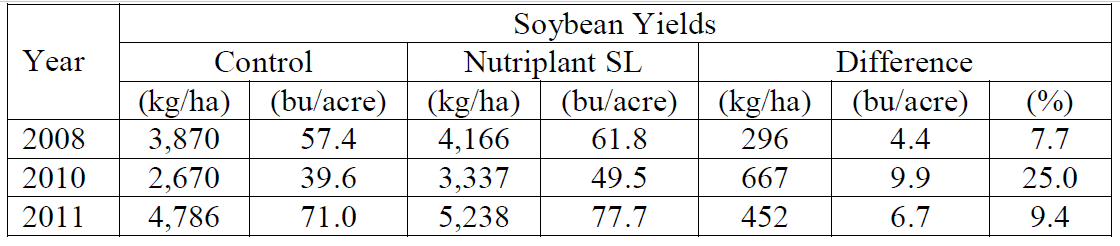
Application of Nutriplant SL in-furrow at planting increased soybean yields by 296 kg/ha (4.4 bu/acre) in 2008, a 7.7% increase over the untreated control (Table 2). In 2010, Nutriplant SL increased yields by 667 kg/ha (9.9 bu/acre), a 25% increase over the control and in 2011 by 452 kg/ha (6.7 bu/acre), a 9.4% increase over the control. The average yield increase for the three years was 472 kg/ha (7 bu/acre), a 14% increase over the untreated control. In all three years, the crop was exposed to high winds and in 2008 also to unusually high temperatures early in the season, indicating that Nutriplant SL applied in-furrow helped overcome the negative effects of abiotic stress. In 2010, soybean yields at the IRF were the lowest on record since testing began in 1999 and 900 kg/ha (13.4 bu/acre) less than the 3,573 kg/ha (53 bu/acre) average. Treatment with Nutriplant SL increased yields by 667 kg/ha (9.9 bu/acre) bringing them closer to the average. These results are consistent with the effects of Cytozyme products on dryland and irrigated winter wheat, when the greatest yield increases were observed in years when the wheat was exposed to extreme abiotic stress of heat and drought.
Table 2. Effects of Nutriplant SL applied in-furrow at planting time on soybean yields. Irrigation Research Foundation, Yuma, Colorado, USA.
The evaluation of these two methods of application of Nutriplant SL to the seeds indicated that in-furrow application is more effective than direct application to the seeds. Superior results with in-furrow application may be explained by the fact that during soybean seedling growth, the seed coat where the treatment is applied is lifted above the ground reducing effectiveness of the product but when applied in-furrow, the product stays near the root system of the seedling allowing for longer exposure of the plant to the product.
Conclusions
The in-furrow application of Nutriplant SL to soybeans is more effective method than direct application of the product to the seeds.
In a three year study, Nutriplant SL applied in-furrow increased soybean yields by an average of 14% compared to the untreated control.
References
SBEAUSCO0501
SBEAUSCO0601
SBEAUSCO0801
SBEAUSCO1001
SBEAUSCO1101

 English
 Arabic
 Chinese (Simplified)
 Dutch
Dutch French
 German
 Italian
 Portuguese
 Russian
 Spanish